
“Go straight for souls, and go for the worst.” 
Tag Archives: blog
One Woman’s Stand Against the Lie of Chrislam
This link was blocked from American YouTube. This German woman is a true hero of the faith. At an interfaith concert where Chrislam was being promoted she alone stood, and proclaimed “Jesus is Lord!” as everyone else sat. Click on link below to see what she did.
“How long will you falter between two opinions? If the Lord is God follow HIm, but if Baal, follow him. But the people answered him not a word.”
Bible Prophecy: Why Study It?
 Amongst Christians, there seem to be two schools of thought concerning Bible Prophecy. One school of thought, possibly the vast majority of Christians, simply chose to ignore it; while at the other extreme they embrace it to the point of ridicule.
So how should we Christians regard Biblical Prophecy? To answer this question we need to look at a few facts concerning prophecy in the Bible and then ask ourselves a few pertinent questions. Hopefully we will be able to come up with a sensible answer to this apparent dilemma.
Firstly, let us make it very clear that we believe, and know, that the Holy Bible is the inspired Word of God.
There are various estimates about how much of the Bible concerns prophecy, but we go along with the view of a number of Bible scholars who have calculated that some 30% of the Bible is prophetic; therefore making  prophecy a substantial portion of the Bible. They also calculate that 80% of Bible prophecy has been fulfilled; leaving 20% of it unfulfilled.
The Bible contains about 31,000 verses and if we assume one prophecy = one verse, we find that over 9,000 Bible verses are prophetic with nearly 2,000 prophetic Bible verses remaining to be fulfilled.
Since God included so much prophetic insight in His Word, how can we simply ignore it? Primarily prophecy is a message from God, not merely foretelling future events. Of course it goes without saying that we have to be careful not to interpret unfulfilled prophecy to suit our position, whatever that may be. Date setting is one particular example where some Bible scholars have opened themselves up to ridicule, as well as bringing disrepute upon Christians in general and the Bible in particular.
So yes, we believe in the importance of Bible prophecy and the need to study it to try to help us explain some of the events currently taking place or unfolding in the world. Some of these we will look at and discuss from time to time.
We also believe that we need to be aware of the “signs of the times” so that we are not like the people (and religious leaders) of 2,000 years ago who, from prophetic scriptures then known to them, should have known the time of Jesus’ coming.
We don’t want the rebuke they received from Him when he said in Luke 12: 56:
“Hypocrites! You know how to interpret the appearance of the earth and the sky. How is it that you don’t know how to interpret this present time?” NIV
Chris, from our fellowship, has an interest in Bible prophecy and from time to time will share his views with us on current events and how they relate to prophecy in the new series of “Bible Prophecy” on this blog.
594 of His Last 600 Sermons Wesley Preached on the Street
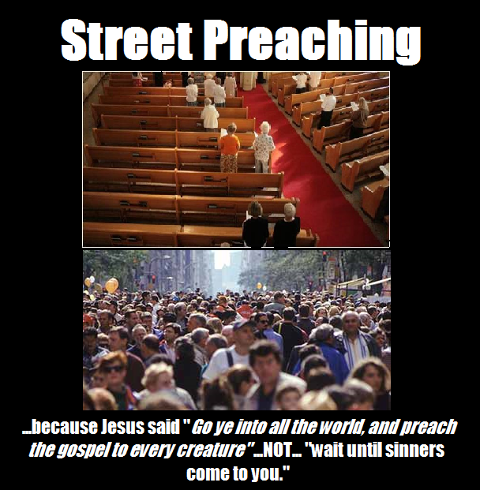 Here is a list of the “persecutions” that I have personally suffered whilst street-preaching:
- Been called an “idiot” to my face
- Been mocked and ridiculed
- Been leered at
- Been outright laughed at
- Been screamed at to “shut-up”
- Been heckled
- Rude gestures made at me
- Blasphemies and curses screamed at me
- Having the cord of the PA system pulled out while I preach
- People taking photos of their friends standing next to me
- People trying to rip the microphone out of my hand
- Another PA system turned up loud to drown me out
- Man putting his arm around me
BIG DEAL
Maybe it will get worse, I don’t know. Maybe if you went out you would be beat up or put in jail or worse, I don’t know that either.
But what I do know is that there is a whole generation out there going to hell. HELL.
(Do you really believe it?)
And why are they going to hell? Largely because of:
- Our fear of man
- Our excuses
- Our feebleness in following Christ
- Our “ministries” and church mindsets
- Our busy lives
Why are we just letting Satan do whatever he pleases?
And that IS what he is doing. If you don’t believe me, go out there and see for yourself the kids on drugs, the alcoholics, the homeless people, the business people spending their lives coveting, the girls wearing hardly clothes for attention. Go to your nearest city and just sit and observe.
Open your eyes and open your heart.
That man with tattoos on his face, Jesus died for him.
That kid wandering aimlessly, Jesus died for him too.
That young woman with skinny legs and a hole on the inside of her elbow, Jesus shed His blood for her too.
“How then shall they call on him in whom they have not believed? and how shall they believe in him of whom they have not heard? and how shall they hear without a preacher?” (Romans 10:14)
You know, I’ve seen it with so many Christians, myself included. We are so nice and polite. We don’t want to offend people. “Best not to cause waves by shoving the gospel down people’s throats….”
And meanwhile the devil rubs his hands in glee and dances all over our craving to be accepted.
Jesus never told us to be gentle with the devil. He never told us to accommodate him in any way or let him walk all over us. No sir.
He did in fact say: “Behold I give you authority to trample on snakes and scorpions and to overcome all the power of the enemy, nothing in any wise shall harm you.” Luke 10:19
One of the most powerful and effective forms of spiritual warfare is to preach the gospel. Go to the sinners, don’t preach to the converted. Get to where the sinners are and preach your heart out.
“Preaching is not a profession, it’s a passion” said Leonard Ravenhill.
Let’s get so full of the Holy Ghost fire that we are constrained by the love of Christ to take the good news of the Kingdom to the lost.
Let’s stop being cowardly, let’s stop being polite and comfortable, let’s meet the devil head on and give him something to worry about!
You can read more about what happened as I street-preached tonight here
Watch this for inspiration:
In Jesus name
Amen and Amen
The “Emergent”-cy of Post-Modernist Christianity
 Following on from my last post “Where’s Truth?” , where we looked at the effects of post-modernism on absolute truth, I would now like to take a look at how post-modernism is affecting the professing Christian church, in particular the Emergent, or Emerging Church.
My purpose in doing this series is not to attack individuals per se, although it would be impossible not to name some key players, but to bring to light the philosophy behind much of the Emergent Church, where it is leading and where it will ultimately end up. Whilst there are some aspects of the Emergent Church which are not all bad, I think it is important to understand what it is that is propelling this movement forward and its ultimate purpose.
I am in no way a philosopher as such, but I do think that it would be wise first to consider the astronomical effects with which philosophy has affected society, culture and humanity. One needs only to look to Plato or Aristotle to see how their social philosophies have affected human eugenics theory, leading to the immoral abortion crisis in the world today. Another example is German philosopher Karl Marx, whose social theories influenced politics such as Leninism, Stalinism, Trotskyism and Maoism, and history tells the culmination of these regimes.
Philosophy is, according to Wikipedia,: “the study of general and fundamental problems, such as those connected with reality, existence, knowledge, values, reason, mind, and language. Philosophy is distinguished from other ways of addressing such problems by its critical, generally systematic approach and its reliance on rational argument. In more casual speech, by extension, “philosophy” can refer to “the most basic beliefs, concepts, and attitudes of an individual or group.”
So when we talk of philosophy, it is not some “pie-in-the-sky” thoughts and theories that have no bearing on our world, it is the exact opposite. As I see it (for what it’s worth) various branches of philosophical thought are published, usually through universities and the world of academia, it filters through to the students, it enters the workplace and the media in all its forms and eventually takes hold in the political realm as human opinion shifts into a new paradigm of belief and value systems.
So to get back to the Emergent Church and how it fits in with all of this. The Emergent Church has recognized that we are now living in a Post-Modern world and that people think differently from how they used to think. Their position is that because society has changed, in this new world the old ways of doing “church” and Christianity no longer work. Therefore a movement has begun that seeks to transform Christianity into something new – something that appeals to this post-modern generation, something that is relevant.
And just like any other movement in society, this Emergent movement is underpinned by a system of Post-modernist philosophy. This system is called “de-constructionism”.
Next time I will discuss the following in “Satan’s Tool in the Emergent Church”:
- What is de-constructionism?
- Who is history’s first de-constructionist?
- What is the ultimate aim of de-construction in the Christian church?
- Where will it lead?
Missionary Quotations- CT Studd1
 “If Jesus Christ be God and died for me, then no sacrifice can be too great for me to make for Him.”
Where’s Truth?
We live in a post-modern world where the existence of absolute truth is outright denied.
Have you ever heard (or said) this sort of statement:
“Your truth is good for you, but I have my own truth.”
This is post-modern relativism in a nut-shell.
But is that statement logical? Can it be possible for every person on the face of the planet to have their own “truth” and yet they are ALL simultaneously true?

Or is there an absolute Truth? And if so, what is it?
Firstly I would like to look at post-modernism and its effects on absolute truth.
To start the definition of “post-modernism” is:
“A relativistic system of observation and thought that denies absolutes and objectivity. Postmodernism has influenced theology, art, culture, architecture, society, film, technology, and economics. Traditional social, art, social, and cultural, constructs are discarded and reinterpreted in relativistic terms.” http://www.carm.org/dictionary/dic_p-r.htm (accessed September 16, 2008).
Wikipedia : “Postmodernism is a late-20th-century movement in the arts, architecture, and criticism that was a departure from modernism.[1][2] Postmodernism includes skeptical interpretations of culture, literature, art, philosophy, history, economics, architecture, fiction, and literary criticism. It is often associated with deconstruction and post-structuralism because its usage as a term gained significant popularity at the same time as twentieth-century post-structural thought.”
Post-modernism played out is this statement :
“Well that’s your truth, and that’s good for you, I have my own truth that works for me.”
In post-modernism, truth becomes relative and subjective. I can determine my truth, you can determine your truth etc. “Truth” becomes subject to each individual’s own desires, beliefs systems and world-views and an objective truth (something outside of us) is thrown away. The end result of this relativism is that right and wrong and good and evil also become subject to our own personal opinions because a static point-of-reference is denied.
Here’s an example of what I mean. I spoke to a man one day who denied the existence of both good and evil.
“It’s all relative,” he claimed.
So I asked him what would happen if someone stole his car or his wallet, would he consider that wrong?
“No”, he answered, “because I do not hold onto my possessions.”
I asked him what if it was his child that was stolen, what if his child was groomed by a pedophile and molested? Would that be evil?
“No”, he said, “There is no evil, there’s only what we as a society define as evil or good.”
“Do you have kids of your own?” I asked.
“No.”
I dare say that if he did, his answer would have been very different.
This is the logical conclusion of post-modernism – that there is no real truth, no good, no evil, not even gender distinction, just what we, as a society, label as such. All moral reference points are removed and we are left to flounder along as each determine. Dr Ravi Zacharias used the example of when you are stopped in your car at a traffic light and the next car is slightly rolling. It is difficult to determine whether it is your own car, or the one next to you that is moving until you find a static point-of-reference, such as a pole on the side of the road.
Biblical Christianity maintains that there exists ABSOLUTE TRUTH determined by a Sovereign, holy, moral God who created all things. It claims that this truth is objective, determined by something or someone other than us and that this Truth is the “pole”, or the point-of-reference for humankind.
I would like to seek to prove that ABSOLUTE TRUTH does exist. Take mathematics for example. Lately I have been teaching my daughter the multiplication tables. We have been learning that :
1 x 2 = 2
2 x 2 = 4
3 x 2 = 6
And so on.
The answers to these mathematical questions are fact, or truth. They are facts which neither you nor I can alter. They are facts on which buildings, bridges and airplanes have been created by humans.
I may decide that I don’t like the fact that 2×2=4, but my desire to change the truth of this equation does not in fact do anything to alter it. All I will succeed in doing is making my own life difficult, or building a bridge that falls down, because 2×2 does equal 4 and nothing I can do will change that established fact. I could try to fight for my rights to deny this truth, so I could say that 2×2 doesn’t equal 4, yet, in reality, the mathematical table remains unchanged and untouched by my own personal opinions and desires.
A Biblical example is the Ten Commandments. This is God’s moral law which declares that those who have broken His Law are sinners, law-breakers and transgressors. This Law is truth, it is outside of us and will never be subjected to humanity’s own desires or whims nor society’s changes.
(In abbreviated form):
You shall have no other gods before[a] me.
“You shall not make for yourself an image in the form of anything in heaven above or on the earth beneath or in the waters below. 5 You shall not bow down to them or worship them
“You shall not misuse the name of the Lord your God, for the Lord will not hold anyone guiltless who misuses his name.
“Remember the Sabbath day by keeping it holy.
“Honor your father and your mother, so that you may live long in the land the Lord your God is giving you.
“You shall not murder.
“You shall not commit adultery.
“You shall not steal.
“You shall not give false testimony against your neighbor.
“You shall not covet your neighbor’s house. You shall not covet your neighbor’s wife, or his male or female servant, his ox or donkey, or anything that belongs to your neighbor.”
Whilst I may decide that murder, or sexual immorality is not actually wrong and that it’s ok to lie if it’s a little, white lie, this does not in fact change the truth that murder, sexual immorality and lying is wrong and sinning against God and other people. And to deny that truth and to live as if it didn’t exist or didn’t matter only will make life (and eternity) difficult for me.
So then logically what I’m trying to say is that: truth by its definition is exclusive.
To qualify that statement I will use an analogy. Suppose I had red hair. If I were to ask two different people what colour my hair is and one said “black” and the other said “red” – only one of these answers would be in fact TRUE. (Bad example, but I hope you see what I’m getting at.) By virtue of the fact that my hair IS red, the other statement is disqualified as UNTRUE. Only one statement can be true. Just as in maths, 1×2 cannot equal both 2 and 13 at the same time, so too is truth exclusive.
To say that we can all determine our own truth (“that your truth is fine and my truth is fine too”) is not logical. It denies the very premise of truth itself. And it very obviously renders the question back:
“Well if there is no absolute truth, then why should I believe the very statement that there is no absolute truth? Isn’t claiming that there is no truth actually making an assertion of truth?”
Relativism by nature undermines itself.
So what’s left?
TRUTH.
Jesus said “You shall know the truth, and the truth shall make you free.”
There is a God who created the universe. Just as behind every painting there is an artist and behind every building there is an architect, so too behind our delicately balanced eco-systems, our beautifully laid out solar systems and galaxies, behind our moral laws of right and wrong, there is The Artist of artists, the Architect of architects, the Judge and Law-Giver to whom we each must one day give an account of our lives.
Jesus said “I am the Way, the TRUTH and the Life. No man comes to the Father but by Me.”
You may choose to reject that statement as untrue, and that is your right.
But if you care about Truth the logical thing to do, if you were honest with yourself, would be to find out for yourself whether it is True or otherwise.
I would love to hear from you. Please feel free to comment below.
Blessings!
Next post ….. The “Emergent”-cy of Post-Modernist Christianity
Missionary Quotations – Amy Carmichael1
 “What is the secret to great living? Entire separation to Christ and devotion to Him. Thus speaks every man and woman whose life has made more than a passing flicker in the spiritual realm. It is the life that has no time for trifling that counts.”
Of Worth and Esteem
I will praise the Lord
Because He is worthy to be praised.
Oh Lord I lift up Your Name
Oh Lord I praise the Name of Jesus
Help me to remember
Help me to remember
Help me to remember
To lift my eyes UP-
From myself
From my circumstances-
Up to You (from whence my help comes)
You are worthy of all praise
My feelings and emotions have no place
Nor is it of any consequence whether
My life is good
Nor whether it is difficult
It is all about YOU
You are worthy
Self and its esteem (self-esteem) become irrelevant in the face of Jesus Christ
Christ and our esteem of Him (Christ-esteem) is that which determines the course of our lives.
“Worthy is the Lamb who was slain
To receive power and riches and wisdom
And strength and honor and glory and blessing!” (Revelation 5:12)
Love Looks Like Something
We can talk about Love
all we want,
Philosophize,
Discuss and reason
Talk about how it should feel
Until it becomes so high and lofty
that it is almost un-real.
But Love, real Love, looks like something
It is practical
Down-to-earth
Love looks like:
Taking food to your neighbour
For their needs to be met,
Or welcoming an outcast
into your precious home
(Would you use your best tea-set?)
Love looks like:
Becoming a friend to someone unlikely
Or calling with encouragement
on the telephone
Love looks like:
Going to the streets
And searching out the lost
to find that one missing sheep
Whatever the cost
Love looks like:
Cold metal nails
Driven into pure hands,
One crying out
“Father, forgive them!”
While His blood pours
To the ground
Love doesn’t always look tidy
Love doesn’t always smell good
Love is not convenient
But Love we should
True Love propels to action,
It is faith in its outworking.
True love is not afraid
To get its hands a little dirty.
If we could just look past
the quasi-“love” that we’ve been sold
We would find that it is the most real thing
In this earth
It’s effects untold…
 Grace and Truth